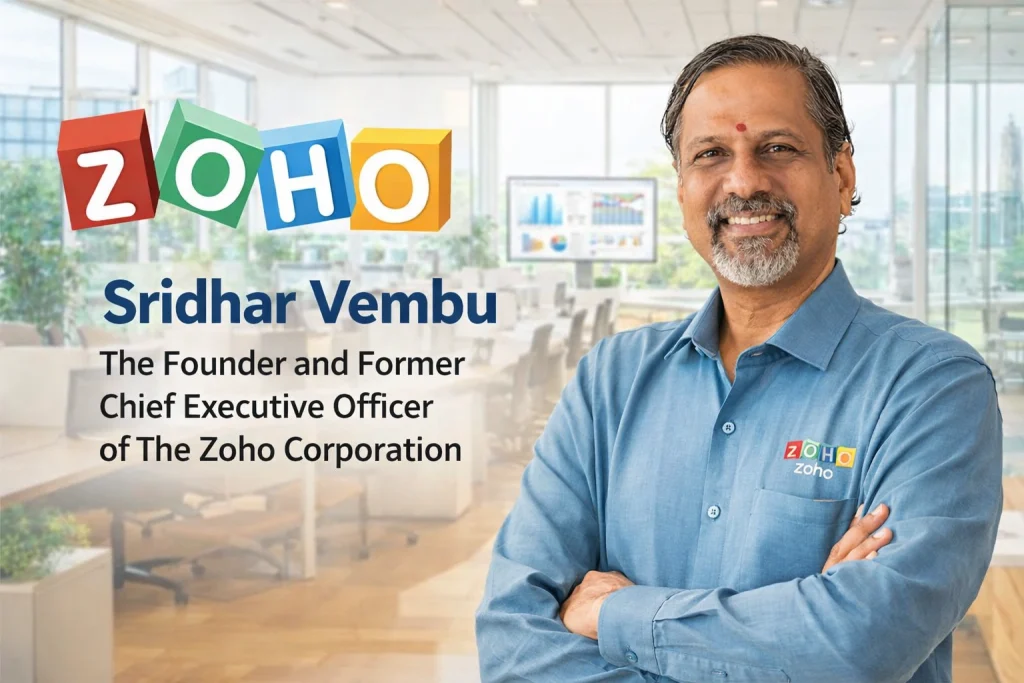

Quick Facts Summary
| Category | Details |
|---|---|
| Full Name | Sridhar Vembu |
| Nickname | Shri |
| Date of Birth | 1968 |
| Age | 57 years (as of 2026) |
| Birth Place | Thanjavur District, Tamil Nadu, India |
| Nationality | Indian |
| Profession | Entrepreneur, Business Leader, Philanthropist |
| Known For | Founder & CEO of Zoho Corporation |
| Net Worth | Approximately $3.75 billion USD (2024) |
| Current Position | Chief Executive Officer, Zoho Corporation |
| Residence | Tenkasi, Tamil Nadu, India |
| Education | PhD in Electrical Engineering from Princeton University |
Personal Information
Zoho Founder Sridhar Vembu is one of India’s most respected and unconventional tech entrepreneurs. Born in a small agricultural village in Thanjavur District, Tamil Nadu, Sridhar Vembu represents the classic rags-to-riches story that inspires millions across India and beyond. Unlike many billionaire entrepreneurs who choose to live in metropolitan cities, Sridhar Vembu made the remarkable decision to move back to rural Tamil Nadu, specifically to the town of Tenkasi, where he continues to lead Zoho Corporation while working on rural development initiatives.
| Personal Details | Information |
|---|---|
| Full Name | Sridhar Vembu |
| Date of Birth | 1968 |
| Age | 57 years |
| Birth Place | Village in Thanjavur District, Tamil Nadu |
| Current Residence | Tenkasi, Tamil Nadu, India |
| Nationality | Indian |
| Religion | Hinduism |
| Zodiac Sign | Information not publicly available |
| Marital Status | Married |
| Net Worth (2024) | $3.75 billion USD |
Sridhar Vembu Wife and Family Life
Information about Sridhar Vembu wife remains relatively private, as the entrepreneur prefers to keep his personal life away from media attention. However, it is known that he is married and values family deeply. His decision to relocate from California to rural Tamil Nadu was partly influenced by his desire to stay connected to his roots and contribute to the community where he grew up.
Family Background & Early Life
Sridhar Vembu’s story begins in humble surroundings that shaped his worldview and entrepreneurial philosophy. Born in 1968 in a small village in Thanjavur District, Tamil Nadu, he grew up in an agricultural family with limited resources. His father was a farmer, and the family faced the typical challenges of rural Indian life – limited access to quality education, infrastructure, and economic opportunities.
| Family Information | Details |
|---|---|
| Father | Farmer (Name not publicly disclosed) |
| Mother | Homemaker (Name not publicly disclosed) |
| Siblings | Has siblings who are also involved in business |
| Spouse | Married (Wife’s name kept private) |
| Children | Information kept private |
| Hometown | Village in Thanjavur District, Tamil Nadu |
| Current Family Residence | Tenkasi, Tamil Nadu |
Despite the financial constraints, Sridhar Vembu’s parents prioritized education. They recognized that education was the pathway out of poverty and invested whatever they could in their children’s schooling. This early emphasis on learning would prove transformational for young Sridhar, who showed exceptional academic ability from a young age.
Growing up in rural Tamil Nadu in the 1970s and 1980s meant dealing with frequent power cuts, lack of study materials, and limited access to quality teachers. Yet these challenges only strengthened Sridhar Vembu’s resolve. He would study by kerosene lamp when electricity failed and walk long distances to school. These formative experiences instilled in him values of resilience, frugality, and self-reliance that would later define Zoho’s corporate culture.
Read also: How Courier Companies Effectively Handle Big Shipping Volumes
Educational Background: From Village School to Princeton
Sridhar Vembu – The founder and former chief executive officer of the Zoho Corporation has an extraordinary educational journey that took him from a government school in rural Tamil Nadu to the prestigious halls of Princeton University.
Educational Journey Timeline
| Year | Institution | Degree/Achievement | Location |
|---|---|---|---|
| 1975-1985 | Local Government School | Primary and Secondary Education | Thanjavur District, Tamil Nadu |
| 1985-1989 | IIT Madras | B.Tech in Electrical Engineering | Chennai, Tamil Nadu |
| 1989-1994 | Princeton University | PhD in Electrical Engineering | Princeton, New Jersey, USA |
School Education
Sridhar Vembu attended a local government school in his village, where resources were scarce but his determination was abundant. Despite studying in Tamil medium and having access to limited study materials, he excelled in mathematics and sciences. His teachers recognized his exceptional abilities early on and encouraged him to aim for the Indian Institutes of Technology (IITs).
IIT Madras – The Turning Point
In 1985, Zoho Sridhar Vembu secured admission to the Indian Institute of Technology, Madras (now IIT Madras), one of India’s most prestigious engineering institutions. This was a monumental achievement for someone from his background. At IIT Madras, he pursued a Bachelor of Technology (B.Tech) in Electrical Engineering.
The IIT experience exposed Sridhar to world-class faculty, cutting-edge research, and brilliant peers from across India. More importantly, it opened his eyes to the possibilities of technology and innovation. He graduated from IIT Madras in 1989 with excellent grades and a burning desire to pursue further research.
Princeton University – Academic Excellence
Following his IIT graduation, Sridhar Vembu was accepted into the PhD program in Electrical Engineering at Princeton University, one of the world’s leading research institutions. From 1989 to 1994, he conducted advanced research in electrical engineering, focusing on topics that were at the cutting edge of the field.
At Princeton, Sridhar developed critical thinking skills, research methodology, and a deep understanding of how technology could solve real-world problems. However, more importantly, he began to question the traditional career path that most PhD graduates followed. While his peers aimed for faculty positions or corporate research roles, Sridhar started thinking about entrepreneurship and building products that could have widespread impact.
Physical Statistics
| Physical Attributes | Details |
|---|---|
| Height | Approximately 5’8″ (173 cm) |
| Weight | Approximately 70 kg |
| Eye Color | Dark Brown |
| Hair Color | Black (now graying) |
| Distinctive Features | Simple, modest appearance; often seen in casual attire |
Zoho Founder Sridhar Vembu is known for his extremely simple and unpretentious lifestyle, often appearing in simple shirts and avoiding the typical corporate executive look. His physical appearance reflects his philosophy of simplicity and substance over style.
Career Timeline: Building a Software Empire
The career journey of Sridhar Vembu – The founder and former chief executive officer of the Zoho Corporation is a masterclass in patient entrepreneurship, strategic thinking, and staying true to one’s values.
Complete Career Timeline
| Year | Milestone | Position/Achievement |
|---|---|---|
| 1994 | Post-PhD | Decided against academic career |
| 1996 | Founded AdventNet | Started with network management software |
| 1996-2000 | Early Growth | Built profitable business serving telecom companies |
| 2000 | Survived Dot-com Bubble | Company remained profitable and bootstrapped |
| 2005 | Launched Zoho Office Suite | Entered productivity software market |
| 2009 | Rebranded to Zoho Corporation | Expanded product portfolio significantly |
| 2009-2015 | Rapid Expansion | Launched 40+ business applications |
| 2015-2019 | Global Growth | Expanded to 50+ countries, 50 million+ users |
| 2019 | Moved to Rural Tamil Nadu | Relocated from California to Tenkasi |
| 2020 | Led Zoho During Pandemic | Company thrived with remote work trend |
| 2021 | Padma Shri Award | Honored by Government of India |
| 2022-2024 | Continued Leadership | Zoho reaches $1 billion+ in revenue |
The AdventNet Beginning (1996)
After completing his PhD from Princeton in 1994, Zoho Founder Sridhar Vembu briefly considered an academic career but quickly realized that his true calling was entrepreneurship. In 1996, along with his siblings Tony Thomas and Kumar Vembu, he co-founded AdventNet in California.
AdventNet started as a network management software company, providing tools that helped IT administrators manage computer networks. The company targeted telecommunications companies and network equipment manufacturers. From day one, Sridhar made a crucial decision that would define the company’s trajectory – AdventNet would be bootstrapped, meaning no venture capital funding. This decision gave him complete control over the company’s direction and allowed him to build for the long term rather than quick exits.
The early years were challenging. The team worked out of a small office, wrote code themselves, and directly engaged with customers to understand their needs. However, this lean approach meant that every dollar earned went back into product development and gradual expansion. By 2000, AdventNet was profitable and serving major telecom companies worldwide.
Surviving the Dot-com Crash (2000-2005)
When the dot-com bubble burst in 2000-2001, thousands of technology companies collapsed, and the industry went through a brutal correction. However, Zoho Founder Sridhar Vembu’s conservative, bootstrapped approach proved to be a blessing. While venture-backed competitors burned through cash and shut down, AdventNet remained profitable and continued growing steadily.
This period reinforced Sridhar’s belief that building a sustainable business was more important than chasing rapid growth fueled by outside capital. It also taught him valuable lessons about financial discipline and the importance of having a viable business model from day one.
The Birth of Zoho (2005)
In 2005, Sridhar Vembu – The founder and former chief executive officer of the Zoho Corporation made a bold strategic move. He decided to enter the emerging market of cloud-based productivity software. This decision was inspired by observing how expensive and complex traditional enterprise software had become.
Zoho Writer, the company’s first web-based word processor, was launched in 2005, directly competing with Microsoft Word and challenging the dominant desktop software model. This was followed by Zoho Sheet (spreadsheet) and Zoho Show (presentations), creating a complete office suite accessible through a web browser.
The vision was revolutionary for its time – software that didn’t need installation, worked from anywhere, was affordable for small businesses, and could compete with Microsoft Office’s dominance. Many industry experts were skeptical that a bootstrapped company from India could challenge Microsoft, but Sridhar was undeterred.
Zoho Corporation Era (2009-Present)
In 2009, AdventNet’s entire product division was rebranded as Zoho Corporation, reflecting the company’s new identity as a comprehensive business software provider. Under Zoho Sridhar Vembu’s leadership, the company expanded aggressively:
Product Expansion: From a handful of office productivity tools, Zoho grew to offer 45+ integrated business applications covering CRM, HR, finance, project management, collaboration, marketing, and more.
Global Reach: Zoho established offices and data centers across the world, serving customers in over 180 countries with 80+ million users.
Revenue Growth: The company crossed $1 billion in annual revenue by 2022, all while remaining profitable and bootstrapped.
Unique Culture: Zoho developed a distinctive corporate culture emphasizing long-term thinking, employee welfare, privacy protection, and reasonable pricing.
Return to Rural India (2019)
In one of the most unusual moves in corporate history, Zoho Founder Sridhar Vembu decided to relocate from California back to rural Tamil Nadu in 2019. He chose Tenkasi, a small town, as his operational base and began working on rural development while continuing to lead Zoho globally.
This decision reflected his philosophy that technology companies don’t need to be based in expensive metropolitan areas and that wealth creation should be distributed more equitably. He established Zoho Schools and rural training centers, creating employment opportunities for local youth who couldn’t afford or access traditional college education.
Major Achievements & Recognition
Sridhar Vembu – The founder and former chief executive officer of the Zoho Corporation has received numerous accolades for his entrepreneurial success and social contributions.
Awards and Honors
| Year | Award/Recognition | Awarded By | Significance |
|---|---|---|---|
| 2021 | Padma Shri | Government of India | One of India’s highest civilian honors |
| 2017 | Economic Times Entrepreneur of the Year | The Economic Times | Recognition for building sustainable business |
| 2019 | Business World Entrepreneur of the Year | Business World Magazine | Excellence in entrepreneurship |
| 2020 | Fortune India Businessman of the Year | Fortune India | Outstanding business leadership |
| Multiple Years | India’s Richest Entrepreneurs | Forbes India | Consistently ranked among top tech billionaires |
Key Achievements
Built a Billion-Dollar Bootstrapped Company: Unlike most technology unicorns that rely on venture capital, Zoho achieved billion-dollar revenue status completely bootstrapped, proving that sustainable growth is possible without external funding.
Global Software Product from India: Zoho is one of the few Indian software products with genuine global reach, competing directly with American tech giants like Microsoft, Salesforce, and Google.
Alternative Education Model: Created Zoho Schools where students are hired after 12th grade and trained in-house, bypassing traditional college education. This model has successfully produced hundreds of skilled software engineers.
Privacy-Focused Business Model: Unlike competitors who profit from user data, Zoho adopted a privacy-first approach, not selling customer data or showing advertisements.
Rural Technology Hub: Established thriving technology operations in rural Tamil Nadu, proving that innovation can happen outside traditional tech hubs and creating local employment.
Pandemic Response: During COVID-19, Zoho quickly adapted products and provided free services to healthcare providers and small businesses affected by the pandemic.
Financial Information
| Financial Details | Information |
|---|---|
| Net Worth (2024) | Approximately $3.75 billion USD |
| Company Valuation | Private company, estimated at $7-10 billion |
| Annual Revenue | $1+ billion (2022 onwards) |
| Ownership | Privately held, no venture capital |
| Personal Salary | Information not disclosed; known for modest lifestyle |
| Wealth Philosophy | Focus on wealth creation through sustainable business, not quick exits |
Financial Philosophy
Zoho Founder Sridhar Vembu’s financial philosophy is radically different from typical Silicon Valley entrepreneurs:
Bootstrapping Over Venture Capital: He believes external funding creates pressure for unrealistic growth and premature exits, which compromises long-term thinking.
Profitability First: Every product and division must be profitable or have a clear path to profitability, ensuring financial sustainability.
Modest Pricing: Zoho deliberately prices products 30-40% lower than competitors to make technology accessible to small businesses globally.
Frugal Operations: Despite being a billionaire, Sridhar lives modestly, focusing resources on R&D and employee welfare rather than executive perks.
Long-term Value Creation: Focus is on building enduring value rather than quarterly results or stock prices, possible only because the company is privately held.
Digital Presence & Contact
| Platform | Information |
|---|---|
| Official Website | www.zoho.com |
| Twitter/X | @svembu (Sridhar Vembu’s personal account) |
| Sridhar Vembu – CEO, Zoho Corporation | |
| Company LinkedIn | Zoho Corporation |
| Public Talks | Regular speaker at technology and entrepreneurship conferences |
| Media Presence | Frequently interviewed by Indian and international media |
Zoho Sridhar Vembu maintains an active presence on social media, particularly Twitter, where he shares thoughts on technology, business philosophy, rural development, education, and public policy. His tweets often reflect deep thinking on economic development, self-reliance, and building sustainable institutions.
Administrative Positions & Social Contributions
While Sridhar Vembu – The founder and former chief executive officer of the Zoho Corporation doesn’t hold formal government positions, he actively contributes to policy discussions and rural development:
Key Positions and Initiatives
| Year | Role/Initiative | Description |
|---|---|---|
| 2019-Present | Founder, Zoho Schools | Alternative education model training rural youth |
| 2020-Present | Rural Development Advocate | Active work in Tenkasi and surrounding villages |
| 2021-Present | Policy Advisor (Informal) | Consulted by government on technology and rural development |
| Ongoing | Agricultural Initiatives | Supporting local farmers with technology and markets |
| Ongoing | Healthcare Access | Establishing medical facilities in rural areas |
Career Philosophy & Vision
Zoho Founder Sridhar Vembu’s business philosophy is unique and counter-cultural in the technology industry:
Core Principles
Transnational Localism: Believes companies should have global reach while maintaining deep local roots. Zoho operates globally but invests heavily in local communities.
Patient Capital: Rejects the venture capital model of rapid growth and quick exits. Believes in building businesses over decades, not just years.
Privacy as a Fundamental Right: Refuses to adopt business models based on data mining and advertising, even though they’re more profitable.
Education Reform: Questions the necessity of traditional college degrees, instead focusing on practical skills and aptitude.
Economic Decentralization: Advocates for distributing economic activity away from crowded metropolitan areas to smaller towns and rural regions.
Self-Reliance: Both personal and national self-reliance are core values. This influenced his support for “Atmanirbhar Bharat” initiatives.
Working Style
Despite being CEO of a billion-dollar company, Zoho Founder Sridhar Vembu – The founder and former chief executive officer of the Zoho Corporation maintains a hands-on approach:
- Regularly reviews product development and strategy
- Personally responds to customer feedback and complaints
- Lives among Zoho employees in rural offices, not in executive isolation
- Maintains frugal lifestyle, traveling economy class and staying in modest accommodations
- Dedicates significant time to teaching and mentoring young employees
Interesting & Rare Facts
Lives in a Village: Despite being a billionaire, Zoho Sridhar Vembu lives in a modest house in rural Tenkasi, Tamil Nadu, working alongside his employees.
No Venture Capital Ever: Zoho has never taken a single dollar of venture capital funding in its 28-year history, an extremely rare achievement.
Transnational Company: Zoho has major operations in India, USA, Japan, China, Singapore, and Europe, but decision-making remains in India.
Alternative Education Pioneer: Zoho Schools have trained 600+ students who never attended college but became successful software engineers.
Pandemic Foresight: Moved to rural India in 2019, before the pandemic, which proved providential when remote work became essential.
Agricultural Interests: Personally involved in farming experiments and supporting local agriculture around Tenkasi.
Privacy Advocate: Publicly criticized big tech companies for data mining practices and built Zoho’s entire business on the opposite model.
Reading Habit: Voracious reader with interests spanning history, economics, philosophy, and science.
Simple Lifestyle: Despite $3.75 billion net worth, lives without luxury cars, private jets, or palatial homes.
Language Skills: Fluent in Tamil, English, and conversant in several other languages.
Educational Impact & Mentorship
One of Zoho Founder Sridhar Vembu’s most significant contributions is reimagining education and creating alternatives to traditional college degrees:
Zoho Schools Model
- Students recruited after 12th grade based on aptitude tests
- Intensive 12-18 month training program combining theory and practice
- Students paid stipends during training
- Job guaranteed upon successful completion
- No education debt burden
- Graduates work on real products from day one
Impact Statistics
- 600+ students trained through Zoho Schools
- 90%+ placement rate in software development roles
- Students from economically disadvantaged backgrounds given priority
- Model being studied by education reformers globally
- Proof that alternative education pathways can succeed
Mentorship Philosophy
Sridhar Vembu – The founder and former chief executive officer of the Zoho Corporation believes in:
- Learning by doing rather than theoretical education
- Identifying potential rather than credentials
- Long-term investment in people over quick hiring
- Building loyalty through opportunity and growth
- Teaching critical thinking and problem-solving over rote learning
Detailed Biography: The Complete Story
Humble Beginnings – The Village Boy with Dreams (1968-1985)
Zoho Founder Sridhar Vembu’s story begins in the heartland of Tamil Nadu, in a small agricultural village in Thanjavur District. Born in 1968 into a farming family, young Sridhar’s early years were defined by simplicity, scarcity, and strong family values. His father worked their modest landholding, and like millions of Indian farmers, faced the uncertainties of monsoons, crop prices, and poverty.
The Vembu household had limited resources, but what they lacked in material wealth, they made up for in aspirations. Sridhar’s parents, though not formally educated themselves, understood that education was the only pathway out of agricultural poverty. They made enormous sacrifices to ensure their children could attend school regularly.
In those years, rural Tamil Nadu faced severe infrastructure challenges. Electricity was unreliable, roads were poor, and quality schools were rare. Young Sridhar walked several kilometers daily to attend the local government school, often studying by kerosene lamplight when power failures made evenings dark.
Despite these challenges, Sridhar showed exceptional academic promise. Mathematics and science came naturally to him. He would solve complex problems in his head and was curious about how things worked. His teachers recognized this rare talent and encouraged him to dream bigger than his circumstances suggested.
The defining moment came when Sridhar’s teacher suggested he prepare for the Indian Institute of Technology entrance examination. For a village boy from a farming family, IIT seemed impossibly distant – both geographically and aspirationally. Yet Sridhar decided to try. Without access to expensive coaching classes that urban students enjoyed, he relied on textbooks, self-study, and determination.
The IIT Dream Realized (1985-1989)
In 1985, Sridhar Vembu achieved what seemed impossible – he cracked the IIT entrance exam and secured admission to IIT Madras, one of India’s most prestigious engineering institutions. This achievement transformed not just his life but his entire family’s trajectory. For a village family, having a son in IIT was extraordinary recognition.
At IIT Madras, Zoho Sridhar Vembu was exposed to a completely new world. Surrounded by brilliant students from across India, world-class professors, and cutting-edge laboratories, he thrived. He chose Electrical Engineering as his major and immersed himself in academics and research.
But IIT gave Sridhar more than technical knowledge. It gave him confidence that he could compete with anyone, anywhere. It exposed him to the possibilities of technology and innovation. And crucially, it connected him with peers who would become lifelong friends and collaborators.
During these four years, Sridhar developed a perspective that would later define his career – that Indian engineers were just as capable as engineers anywhere in the world, and that India could produce world-class technology products, not just provide services.
Princeton and the Road Not Taken (1989-1994)
After graduating from IIT Madras in 1989, Zoho Founder Sridhar Vembu secured admission to Princeton University’s PhD program in Electrical Engineering. This was another significant milestone – from a Tamil Nadu village to an Ivy League institution represented an incredible journey.
At Princeton, Sridhar conducted advanced research and earned his doctorate in 1994. However, this period was also when he began questioning the conventional career path. Most PhD graduates from Princeton would pursue either academic positions at universities or research roles at large corporations. But Sridhar had a different vision emerging.
He observed that while Indian engineers were talented, most worked for American companies or in academic institutions. Very few were building products that the world used. This realization bothered him. Why couldn’t Indians build world-class software products? Why was India known for services but not products?
These questions would shape his next decision – instead of taking a comfortable research position, he would return to entrepreneurship and build a product company.
The Entrepreneurial Leap – AdventNet (1996-2005)
In 1996, Zoho Founder Sridhar Vembu – The founder and former chief executive officer of the Zoho Corporation took the entrepreneurial plunge. Along with his brother Tony Thomas and Kumar Vembu, he co-founded AdventNet in California. The company focused on network management software, providing tools that helped IT administrators monitor and manage complex computer networks.
These were difficult early years. The founding team had technical expertise but limited business experience. They worked out of a small office, wrote code themselves, and personally reached out to potential customers. Money was tight, and every decision had to be financially prudent.
Sridhar made a crucial early decision that would define the company’s trajectory – AdventNet would be bootstrapped. Unlike most Silicon Valley startups that raised venture capital, AdventNet would grow using its own revenue. This meant slower growth but complete control over direction and strategy.
The decision to bootstrap was partly philosophical and partly practical. Sridhar had observed how venture capital often pushed companies toward premature scaling, unrealistic growth targets, and quick exits rather than building enduring businesses. He wanted to build differently.
By 2000, AdventNet had become profitable, serving major telecommunications companies worldwide. The company had proven that a bootstrapped Indian company could compete globally in technology products. This was still rare in the late 1990s when Indian IT was synonymous with services, not products.
Surviving the Crash and Pivoting (2000-2005)
When the dot-com bubble burst in 2000-2001, the technology industry experienced a brutal correction. Thousands of companies collapsed almost overnight as funding dried up and business models proved unsustainable. This was a moment of truth for countless startups.
However, Zoho Founder Sridhar Vembu’s conservative, bootstrapped approach proved to be a strategic advantage. While venture-backed competitors burned through their funding and shut down, AdventNet remained profitable and continued operations. The company actually gained market share as competitors disappeared.
This crisis validated Sridhar’s approach and taught him valuable lessons about financial discipline, sustainable business models, and the importance of profitability from day one. It reinforced his belief that building slowly but sustainably was superior to growing fast on borrowed money.
During this period, Sridhar also began observing a new trend – the emergence of web-based software. Applications that once required installation on individual computers could now be accessed through web browsers. This “software as a service” (SaaS) model was still nascent, but Sridhar saw its potential.
The Birth of Zoho – Challenging Microsoft (2005-2009)
In 2005, Zoho Founder Sridhar Vembu – The founder and former chief executive officer of the Zoho Corporation made a bold strategic pivot. He decided AdventNet would enter the productivity software market, directly challenging Microsoft Office’s decades-long dominance.
This decision seemed audacious. Microsoft Office was used by hundreds of millions worldwide, was deeply entrenched in corporate environments, and generated billions in annual revenue. How could a bootstrapped company from India compete with Microsoft?
But Sridhar saw an opportunity. Microsoft Office was expensive, required installation and maintenance, and was overkill for many small businesses. What if there was a web-based alternative that was affordable, accessible anywhere, and sufficient for most business needs?
Zoho Writer was launched in 2005 as a web-based word processor. It was followed by Zoho Sheet (spreadsheet) and Zoho Show (presentations), creating a complete office suite accessible through any web browser. The products were offered at a fraction of Microsoft Office’s price, with free tiers for individual users.
The tech industry watched with skepticism. Many analysts doubted that a small Indian company could build products good enough to compete with Microsoft. But Zoho Founder Sridhar Vembu was undeterred. He believed in his team’s capabilities and had a long-term vision.
By 2009, Zoho’s office suite had millions of users globally. The company decided to rebrand its entire product division as “Zoho Corporation,” reflecting its new identity as a comprehensive business software provider rather than just a network management company.
Building the Zoho Ecosystem (2009-2019)
The period from 2009 to 2019 was one of aggressive expansion for Zoho. Zoho Founder Sridhar Vembu led the company in launching new products across multiple categories:
Customer Relationship Management (CRM): Zoho CRM became one of the leading alternatives to Salesforce, offering similar functionality at much lower prices.
Human Resources: Zoho People and Recruit provided HR management and recruitment solutions.
Finance & Accounting: Zoho Books, Invoice, and Expense helped businesses manage their finances.
Project Management: Zoho Projects competed with tools like Asana and Basecamp.
Collaboration: Zoho Cliq, Connect, and Meeting provided team communication and video conferencing.
Marketing: Zoho Campaigns, Social, and PageSense helped businesses with digital marketing.
By 2019, Zoho offered 45+ integrated applications covering virtually every business function. This comprehensive suite, all working together seamlessly, became Zoho’s unique advantage. Small and medium businesses could run their entire operations on Zoho’s platform.
The company also expanded geographically, establishing offices and data centers in the United States, Europe, Japan, China, Singapore, Australia, and across India. Zoho was now serving customers in over 180 countries with 50+ million users.
Throughout this growth,Zoho Founder Sridhar Vembu – The founder and former chief executive officer of the Zoho Corporation maintained several distinctive principles:
- Remained bootstrapped – never taking venture capital
- Kept pricing 30-40% below competitors
- Refused to adopt advertising-based business models
- Protected customer data and privacy
- Invested heavily in R&D
- Built products in India with Indian talent
The Radical Return to Rural India (2019)
In 2019, Zoho Founder Sridhar Vembu made perhaps his most unusual decision – he relocated from California to Tenkasi, a small town in rural Tamil Nadu. For a billionaire CEO of a global technology company, this was unprecedented.
Why would someone leave Silicon Valley, the world’s technology capital, for a small Indian town?
Sridhar’s reasoning reflected his evolving philosophy about work, life, and responsibility. He believed that:
- Technology enables location independence: With internet connectivity and modern tools, meaningful work can happen anywhere, not just in expensive metropolitan areas.
- Rural India needs opportunity: India’s economic growth was concentrated in a few cities while rural areas lagged behind. Technology companies could help reverse this by creating employment in smaller towns.
- Personal roots matter: Despite his global success, Sridhar felt connected to rural Tamil Nadu where he grew up. He wanted to give back to similar communities.
- Quality of life: Living costs in rural areas are lower, pollution is less, community bonds are stronger, and life is less stressful.
- Proof of concept: If Zoho’s CEO could operate from rural India, it would prove that technology companies don’t need to concentrate in expensive cities.
Upon moving to Tenkasi, Sridhar didn’t just work remotely – he invested in the community. He established:
Zoho Schools: Training centers where local youth are hired after 12th grade and trained as software engineers, providing alternative pathways to traditional college.
Rural offices: Zoho opened multiple offices in small towns across Tamil Nadu, creating hundreds of jobs for local youth.
Agricultural initiatives: Supporting local farmers with technology, market access, and farming innovations.
Healthcare facilities: Establishing medical clinics to improve healthcare access.
This radical experiment in “transnational localism” – being globally connected while locally rooted – attracted worldwide attention. Media outlets from around the world covered Sridhar’s unconventional choice, and many began questioning whether expensive tech hubs were truly necessary.
Leading Through the Pandemic (2020-2021)
When COVID-19 struck in early 2020, Zoho Founder Sridhar Vembu’s decision to move to rural India proved providential. As cities locked down and companies scrambled to enable remote work, Zoho was already distributed across multiple locations with work-from-home capabilities built in.
More importantly, Zoho’s products became critical infrastructure for millions of businesses suddenly forced to operate remotely. Zoho Meeting (video conferencing), Zoho Cliq (team chat), and Zoho’s entire suite helped businesses survive the pandemic-induced disruption.
Sridhar personally led Zoho’s response to the crisis:
- Made several products free for healthcare providers and educational institutions
- Offered extended free trials for affected small businesses
- Launched new features to support remote work
- Ensured no employees were laid off despite economic uncertainty
- Provided support to rural communities around Tenkasi dealing with health challenges
The pandemic validated Sridhar’s philosophy about distributed work and location independence. While companies in Silicon Valley struggled with expensive office leases and employee
Conclusion
1. Who is Zoho Founder Sridhar Vembu?
Zoho Founder Sridhar Vembu is the visionary entrepreneur who founded and served as former CEO of Zoho Corporation, a global cloud software company bootstrapped without venture capital.
2. What is
Zoho Founder Sridhar Vembu’s net worth in 2026?
Zoho Founder Sridhar Vembu has an estimated net worth of $6 billion (as of October 2025), primarily from his majority stake in Zoho Corporation.
3. Who is Zoho Founder Sridhar Vembu wife?
Zoho Founder Sridhar Vembu wife is Pramila Srinivasan, a health tech entrepreneur and founder of The Brain Foundation. The couple has been estranged since 2021, with divorce proceedings ongoing as of January 2026.
4. Why is zoho sridhar vembu famous?
Zoho Founder sridhar vembu is famous for building Zoho Corporation into a profitable global SaaS giant from rural Tamil Nadu, pioneering bootstrapped tech success and rural education initiatives.
5. What is the current role of Zoho Founder Sridhar Vembu?
As of January 2026, Zoho Founder Sridhar Vembu serves as Chief Scientist at Zoho Corporation after stepping down as CEO in January 2025, focusing on deep R&D and innovation.
Read also : Anil Agarwal: The Visionary Founder Who Built Vedanta from Scratch